
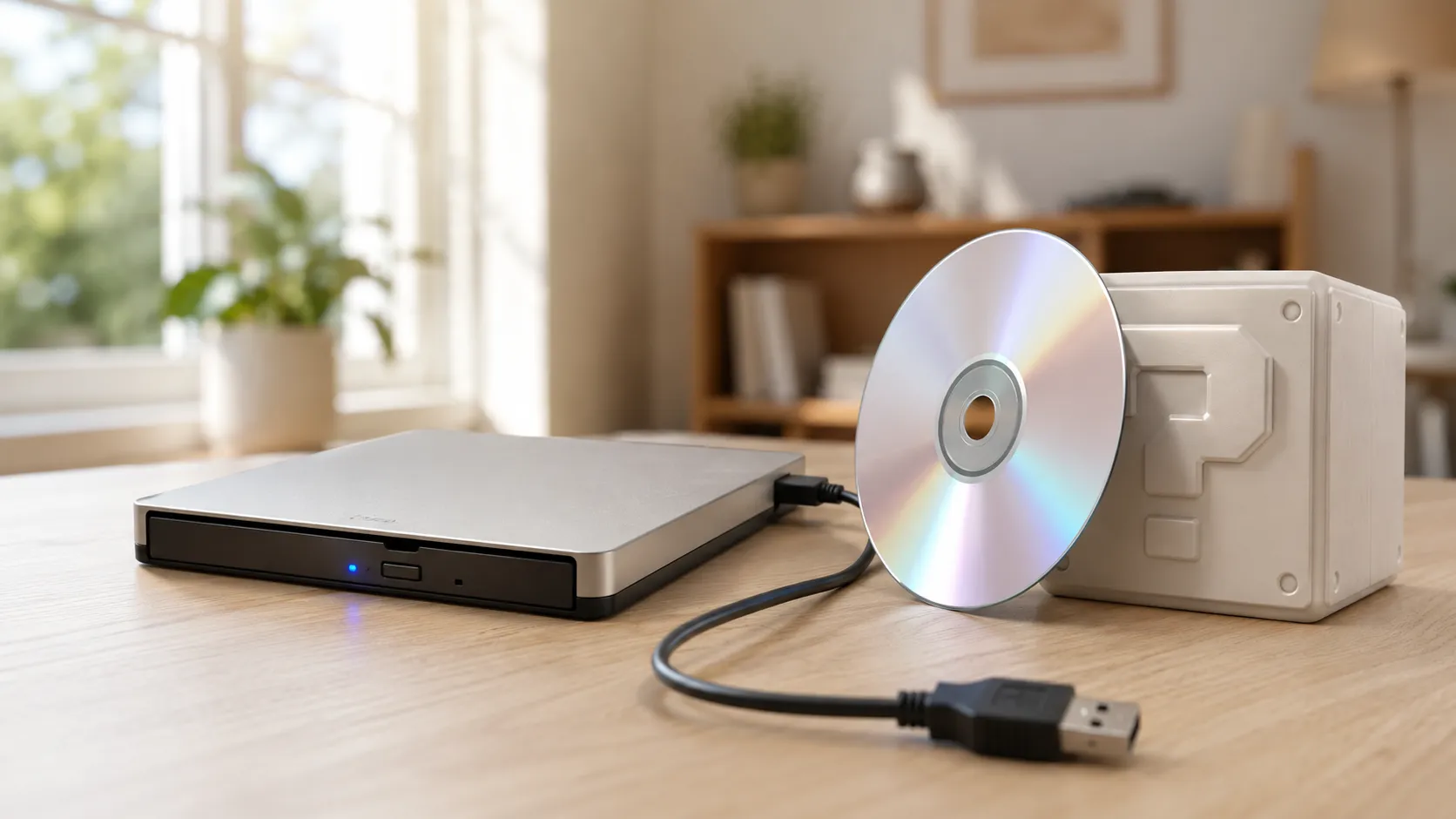
You bought an external USB DVD drive. The listing said it was compatible with Windows 10 and Windows 11. You plugged it in. Windows made the little connection sound. The drive letter appeared in File Explorer. You inserted a DVD. The disc spun up.
And then nothing happened. Or File Explorer opened a folder full of unfamiliar files. Or Windows asked you to choose an app but none of the options worked. The disc is right there, the drive is working, and the movie will not play.
This is one of the most common support questions for external DVD drives, and the answer is almost always the same: the drive is fine. Windows is the problem — not because it is broken, but because it no longer includes the software needed to play DVD movies.
Quick answer: If your external DVD drive appears in File Explorer and the disc spins, the hardware is working. Windows 11 (and Windows 10) do not include a DVD movie decoder. You need a player app that brings its own decoder — VLC (free) or MediaPlay DVD Player (free from the Microsoft Store) will get the movie playing in under two minutes.
Why the drive works but the movie does not play
To understand this, you need to know what a DVD movie disc actually contains. A movie DVD is not like a USB stick with a video file on it. It uses a specific format called MPEG-2, wrapped in a disc structure (the VIDEO_TS folder with .VOB, .IFO, and .BUP files). Playing it requires three things:
- A working drive — to physically read the disc
- An MPEG-2 video decoder — to turn the compressed video data into a watchable movie
- A DVD navigation layer — to handle menus, chapters, subtitles, and audio tracks
Your external drive handles item 1. But Windows 11 does not include items 2 or 3. Microsoft removed the built-in DVD decoder years ago because it required paying a licensing fee for every copy of Windows, and as streaming grew, they decided it was not worth the cost.
This means every external DVD drive — no matter how expensive, no matter what brand — will exhibit the same behavior on a fresh Windows install. The drive works perfectly. Windows just does not know how to play the content on the disc.
The confusing part is that Windows gives no clear error message. It does not say “you need DVD playback software.” It either opens the disc as a file folder, suggests apps that cannot handle it, or does nothing at all. This makes it look like the drive is broken when it is actually working exactly as it should.
Step 1: Confirm the drive is actually working
Before installing anything, take 30 seconds to verify that the hardware side is fine. If any of the following are true, your drive is working:
- The drive appears as a disc icon in File Explorer (usually D: or E:)
- You can see folders or files when you click on the drive
- The disc spins when you insert it
- Device Manager shows the drive under “DVD/CD-ROM drives” without a yellow warning icon
If all of these check out, your drive is fine. Skip ahead to Step 2.
If the drive does not appear in File Explorer at all, that is a different problem — likely a USB connection issue. Try a different USB port (directly on the laptop, not through a hub), try a different cable if one came with the drive, and make sure the laptop is plugged into power. Some slim USB drives draw more power than a single USB port provides when the laptop is on battery.
Step 2: Install a DVD player app
This is the actual fix for most people. You need an app that includes its own MPEG-2 decoder and DVD navigation support.
VLC Media Player is free, open-source, and handles most DVD discs. Download it from videolan.org, install it, then open it and go to Media → Open Disc → select DVD → Play. VLC does not always auto-detect external drives, so if the disc does not start automatically, you may need to manually select the drive letter.
MediaPlay DVD Player is available free from the Microsoft Store and is built specifically for disc playback. If the drive appears in File Explorer but the movie does not start, MediaPlay is designed for exactly this scenario — install, open, and it detects the disc.
Windows DVD Player is Microsoft’s own solution, but it costs $14.99 from the Microsoft Store and has mixed reviews. It works, but the price is hard to justify when free alternatives exist.
Once you have a player installed, insert the disc and open it through the player’s menu. Most players will auto-detect the drive, but if yours does not, manually point it at the drive letter (D:, E:, etc.).
Step 3: If the player is installed and it still does not work
If you have installed a player and the disc still will not play, work through these checks:
The player is not detecting the external drive
Some players default to looking for an internal drive. In VLC, go to Media → Open Disc and check the “Disc device” dropdown — make sure it shows your external drive’s letter, not an empty field or a different device.
The disc is a data DVD, not a movie DVD
Not all DVDs are movies. Data DVDs (home recordings, file backups, photo archives) do not have the standard VIDEO_TS structure. If someone burned files onto a DVD, those are individual video files — open them directly in any media player rather than trying to play the disc as a movie.
How to tell the difference: if you open the drive in File Explorer and see a VIDEO_TS folder with .VOB files, it is a movie disc. If you see regular video files (.mp4, .avi, .mkv) or non-video files, it is a data disc.
The disc is from a different region
DVDs use region coding. A disc bought in Europe (Region 2) may not play on a drive set to North America (Region 1). You can check and change your drive’s region in Device Manager → DVD/CD-ROM drives → right-click your drive → Properties → DVD Region tab. Note that you can only change the region a limited number of times (usually five).
VLC can sometimes bypass region restrictions because it uses its own decoding library rather than the drive’s built-in region check.
The disc is scratched or damaged
If the drive spins up, runs for a few seconds, and then stops, the disc surface may be too damaged to read. Try a different disc. If other discs work, clean the problem disc with a soft cloth, wiping from center to edge (not in circles).
The USB connection is unreliable
External drives are sensitive to USB power and bandwidth. If playback stutters, freezes, or stops unexpectedly:
- Connect the drive directly to the laptop, not through a USB hub
- Plug the laptop into power (some laptops throttle USB when on battery)
- If the drive has a Y-cable with two USB plugs, make sure both are connected
- Try a different USB port — USB 3.0 ports (usually blue inside) are generally more reliable for optical drives
Why this catches people off guard
The reason this problem surprises so many people is that it seems impossible. You bought a device specifically to play DVDs. It is plugged in and recognized. The disc is a real movie. And yet nothing works.
Every other USB device — a mouse, a keyboard, a flash drive, a webcam — works immediately when plugged in. DVD drives are different because the hardware and software are separate concerns. The drive does its job (reading the disc) perfectly. But without a decoder, the data it reads is meaningless to Windows.
It does not help that Amazon listings and product boxes for external DVD drives rarely mention this. They say “compatible with Windows 11” and show a laptop playing a movie, implying that you plug it in and it works. Technically, the drive is compatible — it is the operating system that is missing a piece.
What about Blu-ray drives?
If you bought an external Blu-ray drive hoping to play Blu-ray movies, the situation is more complicated. Blu-ray discs use stronger DRM (encryption) that free players like VLC cannot handle in most cases. You typically need paid software like CyberLink PowerDVD ($60+) for Blu-ray playback.
However, a Blu-ray drive will play standard DVDs just fine with the same player apps mentioned above. So if you have both DVD and Blu-ray discs, the DVD player apps solve the DVD side while Blu-ray requires additional software.
FAQ
Why doesn’t my external DVD drive play movies automatically?
Windows 11 does not include a DVD movie decoder. The drive hardware works, but the operating system cannot decode the MPEG-2 video on the disc. Installing a DVD player app like VLC or MediaPlay DVD Player fixes this.
Do I need to install drivers for my external DVD drive?
Usually not. Windows recognizes most USB DVD drives automatically using built-in drivers. If the drive does not appear in File Explorer or Device Manager, try a different USB port or cable first. Driver installation is almost never the issue.
I can see VIDEO_TS files on the disc. Why can’t I just double-click them?
The .VOB files inside VIDEO_TS contain the movie data, but they are segments of the full movie, not standalone video files. Double-clicking one might play a portion in a media player, but you will not get menus, chapters, or the correct playback order. You need a DVD player app that understands the disc structure.
Will any free DVD player work?
VLC is the most widely used free option and handles most discs. Some other free players may lack DVD navigation support or the MPEG-2 decoder needed for disc playback. If a free player does not work with your disc, try VLC specifically or MediaPlay DVD Player from the Microsoft Store.
My drive worked on my old computer but not on this one. What changed?
Your old computer likely had Windows 7 or an older version of Windows 10 that still included a DVD decoder, or it came with pre-installed DVD software from the manufacturer (common on laptops with built-in drives). Your new computer does not include either, so you need to install a player app.
Can I return the drive if it does not play DVDs?
Before returning it, install a DVD player app and try again. In the vast majority of cases, the drive is working correctly — it is missing software, not defective hardware. If the drive does not even appear in File Explorer after trying different USB ports and cables, then it may genuinely be defective.
Sources
- Microsoft Support: DVD playback in Windows
- VLC: videolan.org
- USB power delivery: usb.org specifications
Final takeaway
If your external DVD drive shows up in Windows but will not play movies, the drive is almost certainly working. The missing piece is a DVD decoder — software that Windows used to include but no longer does.
Install VLC (free) or MediaPlay DVD Player (free from the Microsoft Store), open the disc through the player, and the movie should start. The entire fix takes about two minutes. Save the return shipping label — you probably will not need it.
