
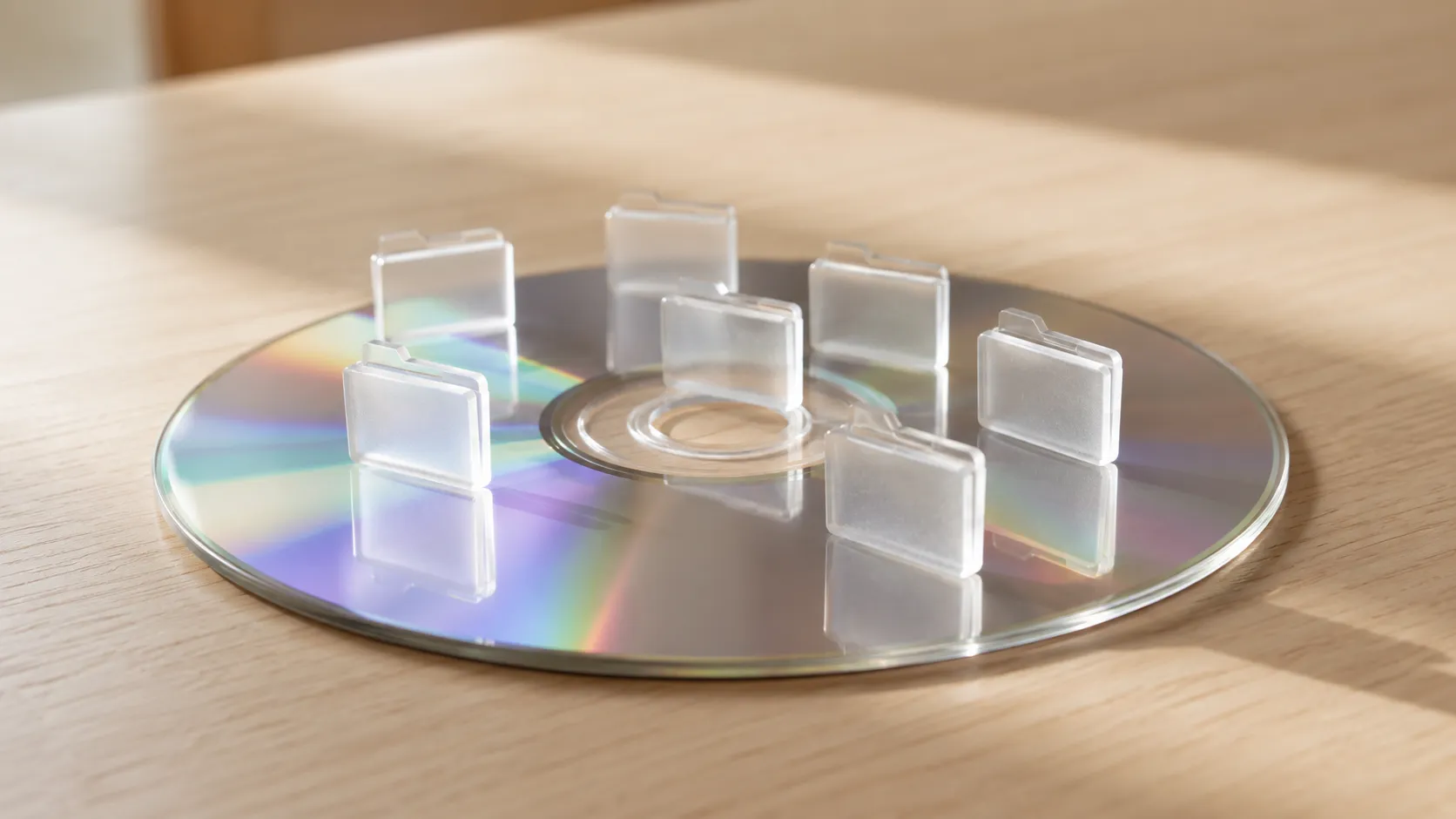
You put a DVD in your computer. Instead of the movie starting, Windows opens a window that looks like any other folder on your hard drive. Inside, you see one or two folders — usually called VIDEO_TS and sometimes AUDIO_TS — and inside those, a collection of files with names like VTS_01_1.VOB, VIDEO_TS.IFO, and VTS_01_0.BUP.
Nothing plays. Nothing looks like a movie. You might try double-clicking one of the files, and a random scene from the middle of the film plays for a few minutes before cutting off. Or Windows asks you to choose a program and none of the suggestions work.
This is not a broken disc. This is not a broken drive. This is Windows showing you the raw contents of a perfectly normal movie DVD, because it does not have the software to play it properly.
Quick answer: The files you see are the movie — stored in a format that Windows can no longer play by default. Install a DVD player app like VLC (free) or MediaPlay DVD Player (free from the Microsoft Store), then open the disc in the player instead of opening the individual files.
What you are actually looking at
When Windows opens a DVD as a folder, it is showing you the raw file structure of the disc. Every commercial movie DVD is organized the same way, and once you understand the structure, the files make sense.
The VIDEO_TS folder
This is where the movie lives. VIDEO_TS stands for “Video Title Set,” and it contains every piece of data the DVD player needs — the video, audio, subtitles, menus, and chapter information.
The AUDIO_TS folder
This folder is usually empty on movie DVDs. It was designed for DVD-Audio discs (a high-fidelity audio format that never caught on). It exists on most movie discs as a placeholder but contains nothing you need.
The files inside VIDEO_TS
There are three types of files, and each has a specific role:
VOB files (.vob) — These contain the actual movie data. The video, audio, and subtitle streams are all wrapped together inside VOB files. A full movie is split across several VOB files (usually around 1 GB each), which is why you see VTS_01_1.VOB, VTS_01_2.VOB, VTS_01_3.VOB, and so on. They are numbered in order, but playing them individually will not give you the correct movie experience — you will miss menus, the correct audio track may not load, and chapter navigation will not work.
IFO files (.ifo) — These are the navigation files. They tell the DVD player where each chapter starts, which audio tracks are available, where the subtitles are, and how the menu system works. Without IFO files, a player would not know how to assemble the VOB segments into a coherent movie.
BUP files (.bup) — These are backup copies of the IFO files. They exist as insurance in case the IFO files are unreadable due to a scratch or disc defect. A DVD player tries the IFO file first and falls back to the BUP file if needed.
Why Windows shows files instead of playing the movie
The short answer: Microsoft removed the DVD decoder from Windows.
Windows 7 was the last version that could play DVD movies out of the box. Starting with Windows 8, Microsoft stopped including the MPEG-2 video decoder that DVDs require. The reason was licensing — every copy of Windows that included the decoder cost Microsoft a per-unit royalty fee, and as DVD usage declined, they decided to cut it.
Without the decoder, Windows treats a DVD movie disc the same way it treats any other disc with files on it — it opens File Explorer and shows you the contents. It does not distinguish between a data backup disc and a Hollywood movie. To Windows, they are both just folders with files.
This is why the experience is so confusing. Windows does not tell you “this is a movie disc and you need player software.” It just shows you files and leaves you to figure it out.
What happens when you double-click the files
If you have tried clicking on the VOB files, you probably noticed some strange behavior:
A random scene plays. VOB files are segments of the movie, but they do not start at the beginning. VTS_01_1.VOB often contains the menu system and studio logos. The actual movie might start partway through VTS_01_1.VOB or in VTS_01_2.VOB. Playing an individual file drops you into whatever segment it contains.
The audio is wrong. DVDs typically have multiple audio tracks — English, Spanish, French, director’s commentary, etc. When you play a VOB file directly, your media player picks whichever audio track it encounters first, which may not be the one you want. A proper DVD player lets you choose the audio track through a menu.
No subtitles. Even if the DVD has subtitles, they will not appear when playing individual VOB files in a generic media player. Subtitles are a separate stream inside the VOB that needs DVD-aware software to extract and display.
No chapters or menus. The chapter markers and menu system are stored in the IFO files, not the VOB files. Playing VOB files directly skips all navigation — you cannot jump to a specific scene or access bonus features.
In short: playing individual files from a DVD gives you a broken, incomplete version of the movie. The files are designed to be read together by a DVD player application, not opened individually.
How to actually play the movie
Option 1: Use VLC Media Player (free)
VLC is the most widely used free media player, and it includes its own DVD decoder.
- Download VLC from videolan.org and install it
- Insert the DVD disc
- In VLC, go to Media → Open Disc
- Make sure “DVD” is selected and the correct drive letter is shown
- Click Play
The movie will start with full menu support, chapter navigation, audio track selection, and subtitles. If VLC does not auto-detect the disc, click “Browse” next to the disc device field and select the drive letter manually.
Option 2: Use MediaPlay DVD Player (free from Microsoft Store)
If you prefer something from the Microsoft Store that is built specifically for disc playback, MediaPlay DVD Player handles DVD detection automatically. Install it, open the app, and it finds the disc.
Option 3: Use another DVD player
Any media player that includes an MPEG-2 decoder and DVD navigation support will work. The key requirement is that the player understands the DVD structure (IFO + VOB files) rather than just playing video files. Not all media players have this — some can play generic video formats but do not support disc navigation.
What not to do
- Do not rename or move the files. The DVD structure depends on the files being in the correct folder with the correct names. Copying individual VOB files to your desktop and trying to play them will not give you the full movie.
- Do not try to convert the VOB files individually. The files are segments, not standalone videos. Converting them gives you disconnected chunks without proper audio or subtitle tracks.
- Do not install random codec packs. Some guides suggest installing K-Lite or other codec packs to “fix” DVD playback. Modern DVD players bring their own codecs. Adding third-party codec packs can create conflicts and cause more problems than they solve.
What if you want to play a VIDEO_TS folder from your hard drive?
Sometimes people copy the VIDEO_TS folder from a DVD to their computer’s hard drive (or receive it from someone as a folder). The same approach works — open VLC, go to Media → Open Disc, but instead of selecting a physical drive, click “Browse” and point it at the folder that contains the VIDEO_TS directory.
VLC will treat the folder exactly like a physical disc, complete with menus and chapter navigation.
Note: MediaPlay DVD Player is designed for physical disc playback. For VIDEO_TS folders on your hard drive, VLC is the better choice.
Is it a movie DVD or a data DVD?
Not every DVD that shows files in File Explorer is a movie disc. Some DVDs are data discs — someone used them to store files like a USB drive. Here is how to tell the difference:
Movie DVD: You see a VIDEO_TS folder containing .VOB, .IFO, and .BUP files. The VOB files are usually around 1 GB each. This is a standard movie disc and needs a DVD player app.
Data DVD with video files: You see regular video files — .mp4, .avi, .mkv, .wmv — sitting directly on the disc without a VIDEO_TS folder. These are individual video files that any media player can open directly. Just double-click them.
Data DVD with non-video content: You see documents, photos, software, or other files. This is a data backup disc, not a movie. Open the files with whatever application they require.
Home-recorded DVD: Someone burned a DVD using recording software. These usually have a VIDEO_TS structure like a commercial movie disc, but the quality and structure can vary. If the disc was not “finalized” (a step required to make recorded DVDs compatible with standard players), it may not play in any player. If you have access to the original recording software, finalizing the disc should fix it.
FAQ
What does VIDEO_TS stand for?
Video Title Set. It is the standard folder name that every movie DVD uses to store its content. The name is part of the DVD specification and is the same on every commercial DVD disc in the world.
Can I delete the AUDIO_TS folder?
On a disc, you cannot modify anything — it is read-only. If you copied the DVD to your hard drive, you can delete the empty AUDIO_TS folder without affecting playback. The VIDEO_TS folder is the only one that matters for movies.
Why are there so many VOB files instead of one big movie file?
The DVD specification limits individual files to about 1 GB due to the UDF file system used on DVDs. A two-hour movie is typically 4-8 GB, so it gets split across multiple VOB files. A DVD player reads them in sequence seamlessly — you never notice the file boundaries during playback.
My DVD shows folders but they are not called VIDEO_TS. What is it?
If the folder names are different (like a movie title, or random names), it is likely a data disc with video files rather than a standard movie DVD. Try opening the individual files in any media player. If they play, the disc is just a data DVD with video content stored as regular files.
Will these fixes work on Windows 10 too?
Yes. Windows 10 also lacks a built-in DVD decoder (unless your computer came with pre-installed DVD software from the manufacturer). The same player apps — VLC and MediaPlay DVD Player — work on both Windows 10 and Windows 11.
I see a VIDEO_TS.VOB file that is very small (under 100 KB). Is the disc empty?
No. VIDEO_TS.VOB is typically just the disc’s intro or FBI warning screen. The actual movie content is in the larger files named VTS_01_1.VOB, VTS_01_2.VOB, etc. If those larger files exist and are around 1 GB each, the movie is there.
Sources
- DVD specification overview: dvddemystified.com/dvdfaq.html
- Microsoft Support: DVD playback in Windows
- VLC: videolan.org
Final takeaway
When Windows opens a DVD as a folder full of files, it is not showing you a broken disc — it is showing you a normal movie that it cannot play. The VIDEO_TS folder, the .VOB files, the .IFO files — these are all parts of a standard DVD, and every movie disc in the world is organized this way.
The fix is to install a player that understands this structure. VLC is free and handles most discs. MediaPlay DVD Player is free from the Microsoft Store and built for disc playback. Either way, you go from staring at cryptic filenames to watching the movie in about two minutes. Leave the files alone, let the player do its job, and the disc works exactly as it should.
